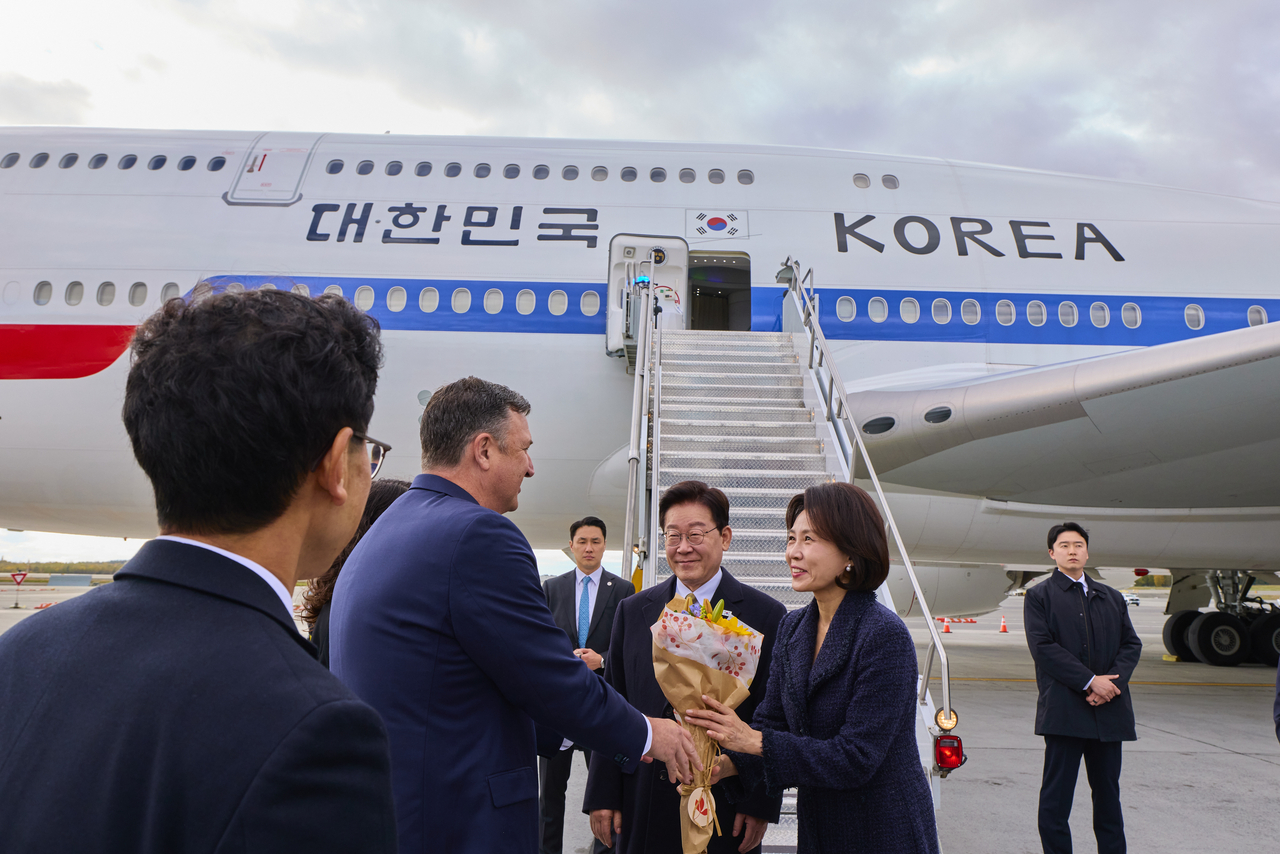
President Lee Jae Myung’s return to Seoul on Sunday comes with a crowded domestic agenda, including a Supreme Court appointment dispute, widening Cabinet vacancies and fallout from suspected land mine explosions in the Demilitarized Zone.
The issues had already spilled into domestic politics, as the ruling Democratic Party of Korea and main opposition People Power Party sharpened their positions on disputes that unfolded or intensified while the president was abroad.
Lee wrapped up a five-night, seven-day trip to New York and Mexico, laying out his vision of peaceful coexistence with North Korea at the UN General Assembly and holding a last-minute one-on-one meeting with US President Donald Trump.
In Mexico, on the first state visit by a South Korean president in 16 years, Lee agreed to launch a bilateral government dialogue on crude oil and critical resources and to broaden cooperation into advanced sectors including artificial intelligence and digital technologies, aerospace and defense.
His return, however, brings the focus back to domestic disputes, including an increasingly public standoff with Supreme Court Chief Justice Jo Hee-de over a vacant Supreme Court seat.
Jo last week rejected Cheong Wa Dae’s request for a new nominee, saying it lacked sufficient justification or constitutional grounds. The presidential office responded with a series of statements expressing “deep regret” and arguing that Jo's position would effectively bind the president to the chief justice’s recommendation.
The dispute began after Jo recommended Daegu District Court Judge Son Bong-kie, whose nomination Cheong Wa Dae declined to forward to the National Assembly in late August.
The ruling party stepped up its criticism Sunday, with senior spokesperson Rep. Park Sung-joon accusing Jo of following “the path of a politician rather than a jurist.”
The standoff comes as a broader restructuring of the criminal justice system enters a critical week.
On Friday, the prosecution service established in 1948 will be abolished after 78 years.
Prosecution and investigation will be formally separated into two new agencies — the new Prosecution Office and the Serious Crimes Investigation Agency — both of which are set to begin operations without chiefs in place.
The leadership vacuum has been compounded by setbacks in Lee’s personnel appointments. Rep. Kim Seung-won withdrew as justice minister nominee on Sept. 19, forcing Lee to restart the search for a minister who will oversee the transition, while the appointment of Kim Ji-yong as the inaugural chief of the Serious Crimes Investigation Agency has been held up in the vetting process.
The personnel gaps extend beyond the justice sector. Presidential policy chief Kim Yong-beom resigned on Sept. 1, while Chief of Staff Kang Hoon-sik offered his resignation on Sept. 21, hours before Lee left for New York. Lee departed without deciding whether to accept Kang’s offer.
If Kang steps down, two of the three top staff posts at Cheong Wa Dae — chief of staff and policy chief — would be vacant. Lee also remains without a gender equality and family minister nominee following Rep. Yong Hye-in’s withdrawal.
Beyond the judicial and personnel issues, the DMZ blasts and the transfer of two North Korean soldiers from Ukraine have added a new layer of uncertainty to Lee’s vision for peaceful coexistence with North Korea.
Three Army officers were injured Sept. 21 in two consecutive explosions, suspected to have been caused by land mines, during a route clearing operation south of the Military Demarcation Line in the western section of the DMZ.
South Korea’s Joint Chiefs of Staff said the military and the UN Command jointly entered the DMZ on Saturday to secure a maneuver route and assess the operational environment ahead of an on-site investigation into the suspected mine blasts.
The People Power Party has ramped up criticism of what it calls delays in the investigation into the blasts.
People Power Party leader Rep. Jang Dong-hyeok said Sunday, “There is a very high possibility that this land mine explosion was caused by a wooden-box mine recently planted by North Korean troops after crossing the Military Demarcation Line.“
“If so, it would constitute a clear act of aggression," Jang said during a press briefing at the Assembly. “Yet the military is said to have begun only preliminary preparations, not a full investigation, five days after the accident.”
The fallout from the DMZ blast comes alongside another controversy over the transfer to South Korea of two North Korean prisoners of war captured by Ukraine.
Ukrainian President Volodymyr Zelenskyy disclosed the transfer Wednesday in a UN General Assembly address. Lee later said Seoul and Kyiv had agreed to keep it confidential because of its potential impact on the prisoners’ safety, diplomacy and the situation on the Korean Peninsula.
The People Power Party accused the administration of trying to conceal the transfer.
Jang also hit back at Lee for calling critics of the government’s handling of the case “murderers” and “traitors,” saying “the root cause of the breakdown in security lies with the president himself.”
Asked whether the party would proceed with a post-Chuseok street rally it has been considering to step up pressure on the Lee administration, Jang said the decision would depend in part on how the government handles “a host of pending issues."
“We will watch a little longer to see how the president and the Democratic Party respond,” he said
dagyumji@heraldcorp.com